z
20% 0.91 TE
The readers are fifteen small convolutional networks, five per case (capitals, lowercase, digits), trained on 255 fonts found on this machine and validated on fonts they never saw. Each one also learned a sixteenth answer, not a letter, from glyphs with a piece erased. That class matters: without it, an earlier version of the readers accepted a lone diagonal and a dot as an A with 0.87 confidence, and the search happily produced exactly that.
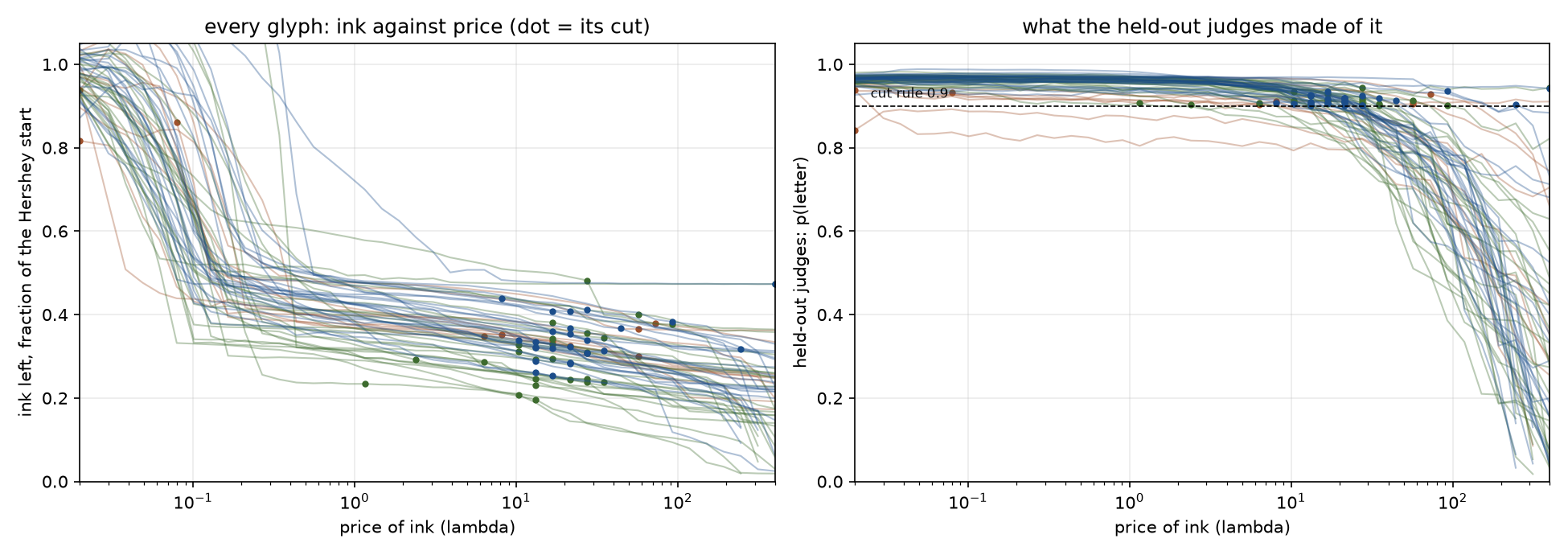
Each glyph starts as the public-domain Hershey skeleton, drawn as strokes with a width at every control point. A price is put on ink and raised in forty steps. At each step the search moves the points and thins the strokes to keep three of the readers convinced, under random rotation, scale, blur, thickening and noise, while paying for every pixel. Strokes cannot go below a floor width, so once thinning is exhausted the only way to save ink is to lose pieces. Two more readers per case never see the search. The cut is the last stage at which both the search readers and the held-out readers still give the letter at least 0.9. That rule was fixed before the sweeps ran. I moved 1 of them back towards more ink after looking at the sheets (0, marked with a dot); the rule only ever lets me add ink, never take more.
0: The Hershey skeleton's two ends meet at the top of the bowl, and the search's first move is to pull them apart: from stage 1 the 0 is a horseshoe, by stage 7 a V, and both judge sets still call every one of them a 0 at 0.92 or better, because no other digit is a horseshoe and the 'not a digit' class did not fire. A person reads U. Moved all the way back to the start, ink 0.97.
Two outside readers of a different kind, Tesseract and EasyOCR, also read every stage. They are stricter than the networks that shaped the letters, which is the point of asking them: at the cut, Tesseract still reads 14 of the 62 glyphs and EasyOCR 14, both 5. Their verdicts are shown under each glyph below and were not part of the rule.
Every glyph at its cut, least ink first. The percentage is ink left compared with the Hershey start, the number is the held-out readers' confidence, and T and E say whether Tesseract and EasyOCR still read it. Across the 62 glyphs the cut keeps 35% of the ink on average; z survives on 20%. The 3 and the 8 never passed the rule beyond their start (the held-out readers were under 0.9 from the first priced stage, or from the start itself) and ship as their Hershey skeletons; so does the 0, by my hand, explained above.
62 GLYPHS × 12 STAGES, ALL SHARING ONE SET OF ADVANCES
The film plays each letter's erosion back, with the readers' verdicts as they change their minds. Watch ENOUGH on YouTube.
Free for any use including commercial, under the SIL Open Font License 1.1. Modify it, embed it, sell things set in it, just don't sell the fonts by themselves, and call any fork something other than Enough. Capitals, lowercase and digits only. Skeletons descend from the public-domain Hershey fonts (Dr. A. V. Hershey, U.S. Naval Weapons Laboratory, 1967). The readers are not people: they are networks trained on the fonts of one Windows machine plus 150 Google fonts, and what they accept is a fact about them, not about you.